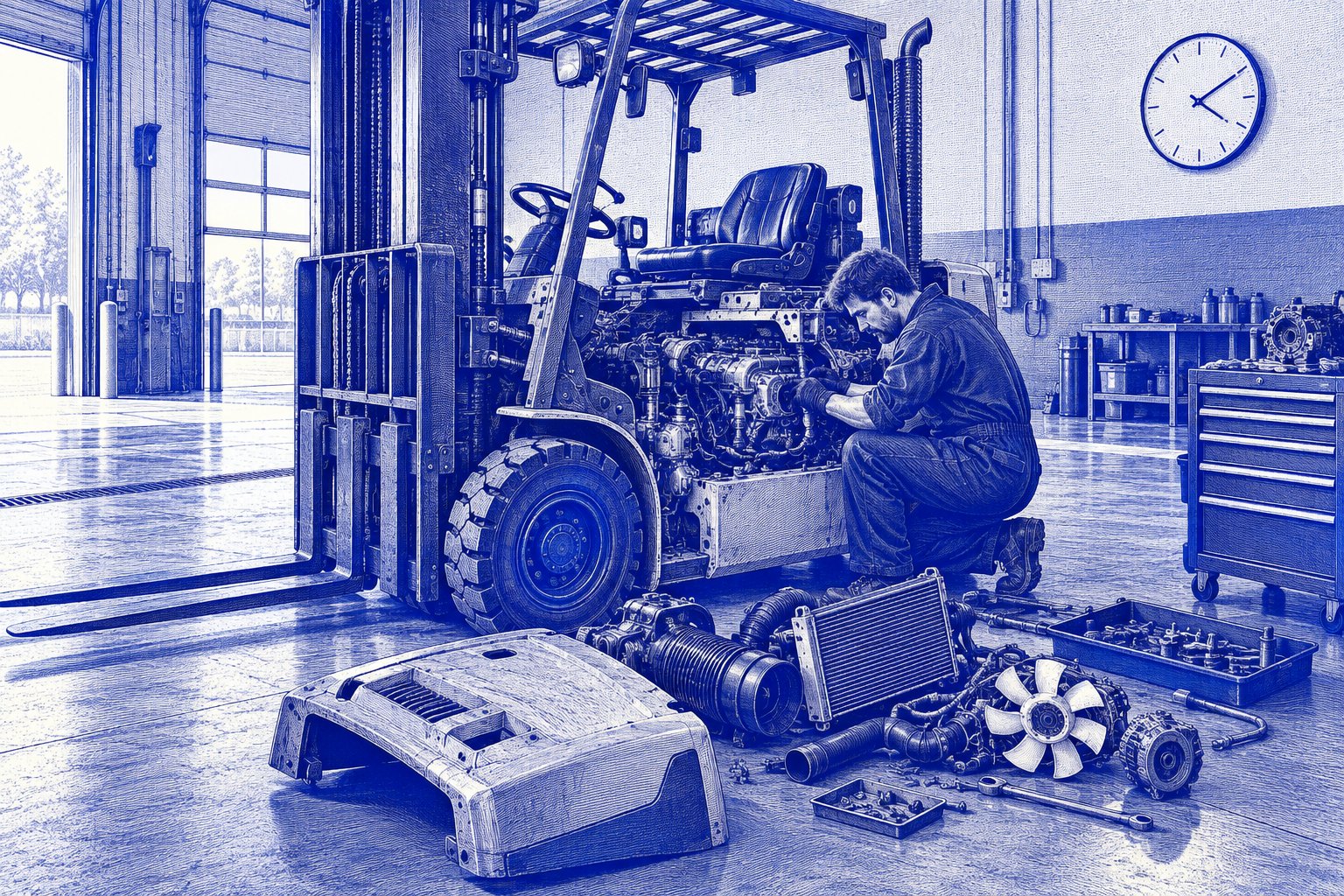
Forklift misdiagnosis consumes time in more than one place: testing the wrong theory, fitting an unnecessary part, reopening the job and explaining the delay. The useful number is your own avoidable diagnostic and comeback time, measured from work orders. The sources reviewed for this article do not establish a reliable, industry-wide average for forklift misdiagnosis hours.
What counts as time lost to an incorrect diagnosis?
A difficult diagnosis is not automatically a bad diagnosis. Intermittent electrical faults, incomplete history and a machine that only fails under particular conditions can require legitimate investigation. The question is whether the work followed a supported testing path and whether the result was verified.
Avoidable time can include repeated tests because findings were not recorded, disassembly based on an unsupported assumption, fitting a part that did not address the cause, another visit for the same unresolved fault, and senior-technician interruptions to reconstruct missing context. Keep necessary troubleshooting separate from rework when reviewing the job.
A fault code, symptom or previous repair is evidence to investigate. It is not a purchase instruction. Confirm machine identity, the applicable reference and the diagnostic finding before turning a theory into a parts order. The diagnostic intake worksheet helps collect that context without pretending every problem has the same sequence of tests.
Why there is no honest universal hours-lost claim here
NIST’s manufacturing-maintenance research associated the most reactive quarter of surveyed establishments with 3.3 times the downtime of the least reactive quarter. That is a broad manufacturing association based on 2016 data, not a measure of forklift misdiagnosis, a causal experiment or evidence of ForkMax savings.
Using a factory-downtime statistic as a dealer’s average diagnostic delay would mix different populations and different units. Machine downtime is elapsed time without the asset. Technician labor is time worked. A truck can wait two days for a part while the technician spends only an hour handling the issue.
For a useful comparison, segment records by repair type, machine family, available documentation and fault complexity. Report a median as well as the average, and retain the number of cases behind each value. A small sample containing one major rebuild should not become a headline about every service call.
A worked example of repeat labor
Suppose a fictional dealer closes 100 repair jobs in a month. Twelve need a return visit for the same unresolved issue. A review attributes an average of 2.5 technician hours per affected job to avoidable repeat work. That is 30 hours: 12 × 2.5. At an assumed fully loaded technician cost of $60 per hour, the labor exposure is $1,800.
These are illustrative inputs, not a benchmark or a prediction. The example does not count every return visit as diagnostic failure. Planned follow-up, customer authorization delays and unrelated new faults must be classified separately.
The $1,800 is a cost-equivalent of labor consumed. It does not mean payroll automatically falls by $1,800 if the process improves. A fixed team may instead use some recovered hours on additional jobs. Calculate that contribution separately, based on actual demand, realization and job margins. Do not add both the full cost-equivalent and the full recovered revenue as if they were independent gains.
Measure the work before changing the process
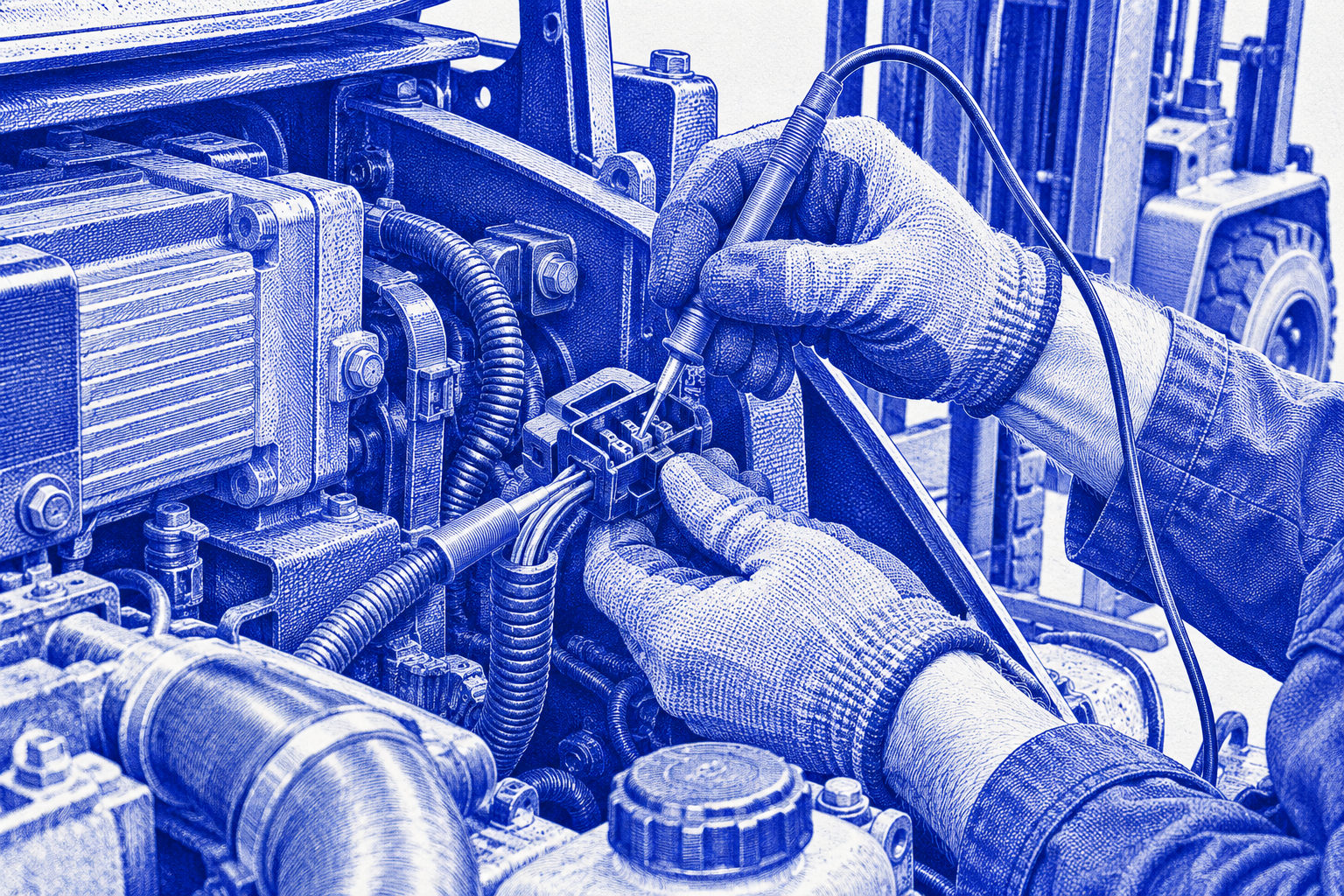
Start with a consistent observation period and the jobs completed during it. Record the initial complaint, machine identifier, evidence available at intake, diagnostic hours, confirmed cause, parts fitted, outcome and any return visit. Track technician identity for coaching and case-mix analysis, rather than treating the data as a simple ranking of people.
For each comeback, have a qualified reviewer classify the reason. Was the first diagnosis unsupported? Was the correct repair performed incorrectly? Was a supplied part defective? Did a different issue develop? Record uncertain cases as uncertain.
Useful measures include diagnostic hours per comparable job, same-fault comeback rate, avoidable repeat hours, incorrect-part returns and time from confirmed finding to completed repair. Keep denominators and definitions stable. A faster close that produces more comebacks is not an improvement.
Where a technician copilot can help
A technician copilot can bring the serial number, symptoms, prior findings and approved references into one working conversation. It can help a technician find a relevant source, see what is missing and retain the checked outcome for later jobs. That reduces the need to reconstruct the same story whenever another person becomes involved.
The technician still verifies the fault using the appropriate tools and procedures. Once confirmed, the agent can pass the repair context to Parts, which can check fit, price and delivery before an authorized order. Admin can then coordinate the next visit. That is a connected workflow to evaluate against your records, not a promise that an AI always diagnoses correctly.
Break the repeat-repair loop.
Common questions
What is the average time lost to forklift misdiagnosis?
The reviewed sources do not establish a dependable forklift-industry average. Calculate your own avoidable repeat hours from classified work orders, and show both the sample size and the mix of repairs.
Is a first-time fix rate enough?
No. Define what counts as a completed repair and a same-fault return, then consider diagnostic hours, parts accuracy and verified repair quality alongside the rate. A rushed first visit can conceal a later problem.
How should a dealer estimate the potential value?
Use observed avoidable hours, a realistic improvement assumption and a separate realization factor for additional work. The value calculator can help distinguish capacity from cash savings.
Sources and context
The primary sources below support the specific statements attributed to them. Worked examples are illustrative assumptions, not industry averages or measured ForkMax results. Labor-market and manufacturing research describe the populations identified in the article.